Create, Brand and Publish Flipbooks with AI

20 September 2026

What if creating an interactive flipbook was as simple as describing what you wanted?

In the second tutorial in our series on using ChatGPT with FlowPaper, we go well beyond importing a PDF. We start with a standard tourist brochure and use ChatGPT to turn it into a branded, interactive publication — changing the appearance, adjusting the toolbar, editing images, adding links and publishing the final result online.

Most of the process is handled through ordinary conversational instructions.

What You’ll Need

There are a few things to set up before you begin.

Start by downloading the ChatGPT desktop app from ChatGPT.com. The desktop version is useful for this workflow because it can work with applications running locally on your computer.

You’ll also need the FlowPaper desktop publisher, available from FlowPaper.com.

Mac users should choose the version that matches their processor — Apple Silicon or Intel. A Windows version is available as well.

Once FlowPaper is installed, launch it and install the ChatGPT integration from the application menu.

Keep FlowPaper open while you’re working and make sure you’re logged in. It’s also a good idea to avoid manually changing the publication at the same time ChatGPT is editing it.


Import a PDF and Preview It in ChatGPT

We begin with a tourist brochure in PDF format.

Normally, you might import the file into FlowPaper yourself and then work through the publication settings manually. With the integration installed, you can simply ask ChatGPT:

Use FlowPaper to import this PDF and show me a preview.

FlowPaper processes the document and returns the interactive publication inside ChatGPT.

From there, you can flip through the pages, inspect the result and decide what you’d like to change next. There’s much less back-and-forth between applications, which makes the editing process feel surprisingly direct.


Apply Your Website Branding

A generic flipbook is useful, but in most cases you’ll want the finished publication to look like it belongs to your website or business.

Rather than hunting down logo files and copying color values one by one, you can point ChatGPT at an existing website and use that as the reference.

For this example, we ask:

Grab the branding colors and logo from NewZealandTrails.com and use them in FlowPaper.

ChatGPT collects the relevant branding information and passes the changes to FlowPaper.

The flipbook is then updated with matching colors and a logo so that it feels much more consistent with the existing website.

The PDF itself hasn’t been redesigned. What changes is the presentation around it, which is often all you need to make an existing document feel properly branded.


Customize the Flipbook Toolbar

The appearance of the publication is only part of the experience. You can also decide which controls readers should have access to.

In the tutorial, we use a simple instruction:

Disable the sharing button and add a download button to the toolbar.

The toolbar is updated without affecting the branding we’ve already applied.

You can use the same approach for other FlowPaper controls. Instead of opening settings panels and working through individual options, you can describe the result you’re after and let ChatGPT handle the configuration.


Edit Images Inside the PDF

This is where the workflow starts to move beyond basic publication settings.

ChatGPT can also help modify the content of the document itself.

On the first page of our brochure, we ask:

Enhance page one by adding a flare to the sky and brightening the image.

The image is edited and passed back into FlowPaper, where the updated version becomes part of the publication.

That means you’re not limited to taking a finished PDF and placing it inside a flipbook viewer. You can make visual changes to the source material as you go, without breaking the overall workflow.


FlowPaper supports interactive elements such as links, hotspots, images and YouTube videos, and these can also be added conversationally.

On page five of the brochure, there’s a photograph of a pair of hiking boots. We want the whole photograph to act as a link, so we tell ChatGPT:

Add a link area to the photo of the feet on page five pointing to https://newzealandtrails.com. Don’t make it a hotspot. Make it a regular link area and have it cover the whole image.

ChatGPT identifies the relevant area on the page and adds the link through FlowPaper.

Being clear about what you want makes a difference here. In this case, we’re deliberately asking for a standard link area rather than a hotspot, and we want it to cover the full image.

If you’re not sure what else is possible, you can ask ChatGPT which interactive elements FlowPaper supports or open the desktop publisher and explore the available options there.


Remove Objects From Existing Pages

We also try a more substantial image edit by removing a person from a photograph on page three.

The instruction is short:

Remove the human on page three.

ChatGPT edits the image and sends the updated page back to FlowPaper.

For the example in the video, there’s no need to open a separate image editor, export the page, make the change and then rebuild the document afterward.

That’s one of the more interesting parts of this workflow. You’re not restricted to a small menu of predefined AI actions. You can describe the change you want in plain language and continue working from there.


Use Your Existing ChatGPT Account

The FlowPaper integration works with your existing ChatGPT account.

You don’t need to buy a separate package of FlowPaper AI credits just to use these features. Instead, the integration uses the capabilities available through your ChatGPT account while FlowPaper handles the publication itself.

The tutorial also touches on a few other possibilities that aren’t demonstrated in detail, including working with multiple publications, modifying text and redacting information from PDFs.

Those examples show how the workflow can extend beyond the branding and image edits covered in this video.

The basic idea remains the same: describe the outcome you want, and let ChatGPT coordinate the changes with FlowPaper.


Publish Your Finished Flipbook

Once the publication looks the way you want, you can publish it without leaving the conversation.

In our example, we ask:

Publish this to FlowPaper Cloud and give me the URL I can use for sharing.

FlowPaper publishes the finished flipbook, and ChatGPT returns the link.

You can then open the publication yourself, copy the URL or send it directly to your audience.

So the workflow runs all the way from the original PDF to the finished online publication without requiring you to manually work through every step.


A More Conversational Way to Work With Flipbooks

This tutorial covers the first version of FlowPaper’s ChatGPT integration, and it already opens up some interesting ways of working.

Rather than adding AI as a collection of isolated buttons or commands, the integration lets ChatGPT work across several parts of the publishing process.

In a single session, we took an ordinary PDF, imported it, previewed it, matched it to an existing brand, changed the reader controls, edited images, added interactive content and published the result online.

There’s plenty more to explore from here.

We’ll be covering additional ChatGPT and FlowPaper workflows in upcoming tutorials.

Ready to try it yourself? Download FlowPaper and start building your own interactive flipbooks with ChatGPT.


How to Turn a PDF into a Shareable Link Online

6 July 2026

Emailing a PDF is straightforward. You attach the file, send the message, and hope the recipient reads it.

The problem is that you usually have no idea what happens next. Did they open the attachment? Did they read the whole document or stop after the first page? Did they click any of the links inside it?

Publishing the PDF online can give you much more useful information.

Using FlowPaper trackable links for better sales follow-up

FlowPaper lets you publish a PDF as an online document and send people a web link instead of a traditional attachment. The document opens directly in the browser, so the recipient does not need to download it before reading.

You can share one general link with everyone, or create a separate trackable link for each customer, prospect, or account.

The second option is particularly useful when you need to follow up with individual recipients.

A public link can show you how the document is performing overall. However, it cannot always tell you which customer opened it or how a particular person interacted with it.

A trackable link gives each recipient their own URL. You can then view the activity associated with that link.

With FlowPaper, you can:

  • Create a unique link for an individual customer or contact
  • Check whether the link has been opened
  • Monitor reading activity and downloads
  • Add an expiry date to documents that should only be available temporarily
  • Receive an email reminder when a recipient has not opened the link

This can be helpful when sharing sales proposals, product brochures, catalogs, reports, presentations, or price lists. Instead of following up at random, you have a better indication of whether the recipient has looked at the material.

Viewing PDF activity in FlowPaper

You can manage your trackable links from the Cloud Publications section of your FlowPaper account.

FlowPaper PDF analytics dashboard showing sessions, reads, time per page, and clicks

Each link includes several options:

  • Copy Link
  • Settings
  • Heatmap
  • Stats

You can look at the statistics for an individual link or review the publication as a whole.

Publication-level analytics include information such as Sessions, Reads, Time/Page, Clicks, and activity over time. This gives you a broad view of the document’s performance while still allowing you to examine the activity associated with a particular recipient.

Follow up when the timing makes sense

A trackable PDF link does more than tell you whether someone received your document. It can also help you decide when a follow-up message is most likely to be useful.

For example, you may see that a customer has opened the document more than once, spent time reading several pages, or downloaded a copy. That does not necessarily tell you what they are thinking, but it gives you more context than an ordinary email attachment.

By publishing a PDF online and sharing it through a trackable link, you turn a static file into a measurable part of your sales or communication process.


Read more

Want the full step-by-step walkthrough, including how to create the links and where to view the analytics?

Read the full guide: How to Turn a PDF into a Shareable Link Online

Is Flipsnack Really the Fastest Flipbook Maker? We Tested It

13 May 2026

Flipsnack claims to be the fastest flipbook maker on the market. We decided to put that to the test — comparing FlowPaper, Flipping Book, and Flipsnack side by side, using the same document and the same conditions.

We focused on three things that actually matter when working with interactive PDFs:

  1. Upload speed — how long it takes to process your file
  2. Load time — how fast the document opens when someone clicks your link
  3. Zoom quality — what happens to the content when readers zoom in

Test 1: Upload Speed

We uploaded the same PDF to all three platforms on the same connection, with a timer running so the results are easy to compare.

FlowPaper processed the file noticeably faster, while the other platforms took longer to handle the same document. If you’re uploading documents regularly — especially larger ones — even small differences in upload time add up.


Test 2: Document Load Time

Upload speed is one thing, but what your audience actually experiences is the time between clicking a link and seeing your content.

We measured this using Pingdom, an independent load-time tool, running each test twice from the same location to eliminate connection variables.

The results:

  • FlowPaper loaded the fastest
  • Flipping Book fell in the middle
  • Flipsnack took the longest to fully render the document

Even modest differences in load time affect engagement — particularly on mobile, where readers are less patient with slow-loading content.


Test 3: Zoom Quality

This one is harder to put a number on, but easy to see with your own eyes.

With FlowPaper, you can zoom in deeply and text stays sharp. That’s because FlowPaper renders content as HTML5 — not as a static image. The result is crisp text and clear visuals at any zoom level.

With Flipping Book and Flipsnack, zoom capability is more limited. With Flipsnack in particular, the drop in quality becomes very noticeable at higher magnification. If your document contains small text or fine detail, blurry rendering will undermine the reading experience.


The Verdict

Across all three tests — upload speed, load time, and zoom quality — FlowPaper came out fastest and most consistent.

Some platforms claim to be the fastest, but based on these results, that claim doesn’t hold up. What matters in the end is how your document actually performs when someone opens it: speed, responsiveness, and rendering quality.

When you see it side by side, the difference is hard to ignore.

Want to see for yourself? Try FlowPaper and compare the results with your own documents.

Version 3.9.4 - Chrome Font Patch

12 March 2026

We’ve released an updated version of the FlowPaper Desktop Publisher: Version 3.9.4.

FlowPaper Chrome Font Patch A recent change introduced in Chrome caused an error in font loading, which affected how fonts were rendered in certain publications created with FlowPaper Desktop Publisher. To address this, we created a patch and released an updated version of FlowPaper 3.9.4, which restores proper font loading and improves compatibility with the latest Chrome updates.

If You’re Using FlowPaper Cloud Hosting

All publications hosted on our cloud have already been patched with this version. No further action is needed for your existing publications.


How to Patch Your Existing Self-Hosted Publications

If you are self-hosting your publications then follow these steps:

  1. Download the latest version of FlowPaper from below.
  2. Import a PDF into the desktop publisher, click "Publish" and choose "Custom Domain"
  3. From the output folder, copy the "js" and "css" folders to your server, replacing the existing ones.

OSX version:
https://flowpaper.com/publisher_builds/FlowPaper_Desktop_Publisher.dmg

OSX Apple Silicon version:
https://flowpaper.com/publisher_builds/FlowPaper_Desktop_Publisher-arm64.dmg

64 bits Windows version:
https://flowpaper.com/publisher_builds/FlowPaper_Desktop_Publisher-x64.exe

32 bits Windows version:
https://flowpaper.com/publisher_builds/FlowPaper_Desktop_Publisher-ia32.exe

Track Who Viewed Your PDF

24 February 2026

Most companies send out PDFs every day — sales proposals, brochures, reports, catalogues — but have no idea if anyone actually reads them.

Did they open it? How long did they stay? Which pages captured attention? Did they click your links?

If you’ve ever wondered how to track who viewed your PDF, this guide will walk you through everything you need to know about PDF analytics, document tracking, page-level engagement, and heatmaps.


Why Traditional PDFs Don’t Provide Real Insights

When you send a standard PDF attachment or upload a raw file to your website, you typically lose visibility. At best, you may know that someone downloaded the document — but you won’t know:

  • How many times your PDF was opened.
  • How long readers spent on each page.
  • Where readers dropped off.
  • Which links inside the PDF were clicked.

Without PDF engagement tracking, your documents become static files instead of measurable business assets.

FlowPaper changes that by turning your PDF into an interactive publication with built-in document analytics and heat maps.

How to Track PDF Views and Sessions

Once you publish your document with FlowPaper, you immediately gain access to built-in PDF analytics.

You can see:

  • Total sessions — exactly how many times your PDF was opened.
  • Impressions over time — track activity during campaigns, launches, or newsletter sends.

This makes it easy to monitor performance right after sending a sales proposal or sharing a marketing brochure.

Measure Average Read Time Per Page

Knowing that someone opened your document is helpful — but understanding how long they actually read it is even more powerful.

FlowPaper provides average read time per page, helping you identify whether readers are deeply engaged or quickly flipping through your content.

For example:

  • If a page receives many views but very little reading time, it may need clearer messaging or design improvements.
  • If a page consistently keeps readers longer, it signals strong engagement and relevance.

This type of page-level PDF tracking allows you to continuously optimize your content.

Track Link Clicks Inside Your PDF

Many PDFs include links to product pages, landing pages, booking forms, or websites. Standard PDFs don’t tell you if those links were ever clicked.

With FlowPaper, you can track external link clicks directly inside your PDF. This is particularly valuable for:

  • Sales proposals with call-to-action buttons.
  • Marketing brochures driving traffic to campaigns.
  • Catalogues linking to product pages.
  • Lead magnets designed to generate conversions.

Now your PDF becomes part of your measurable marketing funnel.

Use Page-Level Analytics to Improve Content

FlowPaper’s page-level document analytics allow you to analyze performance page by page.

For each page, you can see:

  • Number of views
  • Average time spent
  • Engagement interactions

This helps you identify:

  • High-performing pages worth expanding.
  • Low-engagement pages that need redesign or clearer messaging.
  • Drop-off points where readers lose interest.

Instead of guessing what works, you can make improvements based on real reader behavior.

Visualize Engagement with PDF Heat Maps

Heat maps provide a visual representation of how people interact with your publication.

They highlight:

  • Click activity
  • Zoom interactions
  • Areas of high reader interest

The most active sections are clearly displayed, making it easy to spot what draws attention — and what gets ignored.

These PDF heatmaps make content optimization faster and more data-driven.

Turn Static PDFs Into Data-Driven Assets

Instead of sending blind PDFs and hoping they perform, FlowPaper helps you:

  • Track who viewed your PDF.
  • Measure engagement per page.
  • Monitor link clicks and campaign activity.
  • Optimize content using real analytics and heatmaps.

Whether you use PDFs for sales, marketing, investor updates, or product documentation, PDF tracking and analytics help you create more effective content.

Stop sending static documents. Start measuring engagement — and make every PDF smarter.

What Is a Flipbook—and Why Flipbook Makers Aren’t All the Same

15 December 2025

If you’ve ever wanted to embed a PDF on a website, you’ve probably come across the term flipbook. But what exactly is a flipbook—and why are some flipbook makers quite different from others?

What is a flipbook?

A flipbook is a realistic, interactive version of a printed publication that behaves like the real thing. Instead of scrolling through a static document, readers can:

  • Flip pages naturally
  • Zoom in to read details
  • Click links
  • Even watch embedded video (depending on the platform)

The goal is simple: make content easier and more engaging to read than a standard PDF.

The catch: not all flipbook makers treat your PDF the same

While flipbooks look similar at first glance, the technology behind them can be very different.

Some platforms compress your documents heavily, which can cause important details to disappear. The result is especially noticeable when readers zoom in:

  • Text becomes blurry
  • Images lose sharpness
  • The overall experience feels less professional

If your publication represents your brand, that drop in quality matters.

FlowPaper’s approach: keep it crisp with vector-based rendering

FlowPaper takes a different approach. Instead of turning every page into compressed images, FlowPaper processes your PDF as vector-based content.

That means:

  • Crisp text
  • Clear images
  • Smooth zooming—even at high magnification

In other words, readers get a viewing experience that stays sharp no matter how closely they inspect the content.

Compare apples with apples

When choosing a flipbook maker, it’s worth comparing quality at different zoom levels—not just how it looks at 100%.

FlowPaper preserves publication quality using rendering algorithms refined over 10 years, keeping vector detail while removing elements the eye can’t see. The result is a smaller, efficient publication without sacrificing clarity.

Page turns matter too

Quality isn’t only about sharp text and images—page transitions also shape the reading experience.

Many flipbook tools rely on basic, stiff animations that can feel like a slideshow. FlowPaper focuses on smooth, natural page transitions that feel closer to reading a real publication.

Built for professional publishing on any device

From catalogs and magazines to reports and marketing materials, FlowPaper helps your publications look sharp across desktops, tablets, and phones—without compromising quality.

Try FlowPaper

If you want flipbooks that enhance your content instead of degrading it, try FlowPaper and see the difference high-quality rendering makes.

How to Embed PDFs on Your Website the Right Way

30 November 2025

Dropping a PDF into an iframe might technically “work”, but it rarely looks good. It’s clunky, hard to navigate on mobile, and offers almost no insight into how people actually read your content.

In this post, we’ll walk through how to turn a regular PDF into an interactive flipbook using FlowPaper, then embed it into a website (using Squarespace as an example). We’ll also look at how FlowPaper helps you protect your content and track how readers engage with your documents.


Why Not Just Embed a PDF in an iFrame?

Traditional PDF embedding usually means using an iframe or a built-in browser PDF viewer. That approach comes with a few big drawbacks:

  • Limited control over the reading experience.
  • Awkward behaviour on mobile and smaller screens.
  • No meaningful analytics (you only know that someone opened the file).
  • No built-in way to protect your content from being reused elsewhere.

FlowPaper takes a different approach by converting your PDF into a flipbook-style publication that you can embed as part of your page, with interactive navigation and reader analytics.

Step 1: Import Your PDF into FlowPaper

Start by opening FlowPaper and importing your PDF file. Once uploaded, FlowPaper converts it into an interactive publication using the template you’ve selected (for example, a flipbook layout).

You can tweak a range of settings at this stage, such as viewer style and behaviour. For this walkthrough, we’ll keep things simple and focus on getting your PDF online as a flipbook.

When you’re ready, head up to Publish and select Cloud hosted.

Step 2: Upload & Get Your Embed Code

Once you’ve chosen Cloud hosted, FlowPaper processes your publication and prepares it for online use.

  1. Click Start upload to upload your publication to FlowPaper Cloud.
  2. Wait for the upload to finish (this usually takes only a few seconds).
  3. After processing, FlowPaper shows you:
    • A unique URL for your publication.
    • An HTML embed code you can use on your website.

Copy the embed code displayed beneath the publication URL—this is what you’ll paste into your website builder.

Step 3: Embed the Flipbook in Squarespace

For this example, we’ll embed the FlowPaper flipbook into a Squarespace page using a Code block.

  1. Open the page in the Squarespace editor where you want your publication to appear.
  2. Scroll down to the area where you’d like to add the flipbook.
  3. Click Add section and choose Blank section for a clean layout.
  4. Inside that section, click Add block and choose Code.
  5. Squarespace will insert a code block pre-filled with Hello world. Resize the block if needed.
  6. Go back to FlowPaper and copy the embed code for your publication.
  7. Return to Squarespace, click Edit on the Code block, and replace the default text with your FlowPaper embed code.
  8. Click outside the block or hit Apply, then Save and exit edit mode.

Once you view the page in preview or live mode, you should see your FlowPaper flipbook embedded below your main content, ready to scroll through and interact with.

Protecting Your Publications with “Protected Embed”

One of the major benefits of embedding via FlowPaper instead of a raw PDF is the option to protect where and how your content can be used.

In the FlowPaper publishing form, you’ll find a section called Publication protection. It offers:

  • Password protection for restricting access.
  • Protected embed, which ensures your flipbook can only be embedded from approved URLs.

Protected embed works by checking the URL where your publication is loaded. If it doesn’t match the URL(s) you’ve allowed, the publication won’t display. This prevents other sites from embedding your content or linking directly to it outside your website.

To enable protected embed for a Squarespace site, you would, for example:

  1. Copy the first part of your Squarespace URL (your site’s base address).
  2. Paste that into the Protected embed field in FlowPaper.
  3. Re-upload your publication with the updated settings.

From that point on, your flipbook is protected and can only be used from the URL(s) you’ve specified.

Go Beyond Simple Views with Analytics & Heat Maps

Standard PDFs don’t tell you much. At best, you might know that someone clicked a link to your file—but you have no idea:

  • How long they spent reading.
  • Which pages they focused on.
  • Which sections they clicked or interacted with.

FlowPaper provides a suite of document analytics so you can understand how people actually use your content. In your FlowPaper account you can access:

  • Heat maps: Visual overlays that show where readers spend time and where they click inside your publication.
  • Per-page reading time: See which pages hold attention and which are skimmed past.
  • Clicks and reads per session: Understand engagement levels across all your publications.

This is particularly valuable for marketing materials, catalogues, reports, and any document where engagement and performance matter.

Bring Your PDFs to Life

Instead of treating PDFs as static downloads, FlowPaper turns them into interactive, embeddable experiences that look great inside your website, are harder to misuse, and give you real insight into reader behaviour.

Whether you’re adding a catalogue to a Squarespace site, publishing brochures on a marketing page, or embedding reports into a client portal, FlowPaper helps you:

  • Deliver a smoother reading experience than a basic PDF viewer.
  • Protect your publications with features like Protected embed.
  • Track engagement with analytics and heat maps.

Version 3.9.3 Patch: YouTube Preview Fix in FlowPaper Desktop Publisher

23 November 2025

We’ve released a small but important update to the FlowPaper Desktop Publisher.

FlowPaper Youtube Patch Recently, YouTube introduced new security changes that affected how embedded videos load inside third-party applications. This caused YouTube previews to stop appearing when adding video links inside the Desktop Publisher. Today’s update restores full preview functionality. You can once again paste a YouTube link and instantly see the preview inside the editor—no extra steps needed. If you're using video-enhanced publications, make sure to update to the latest version of the Desktop Publisher. More improvements coming soon. Thanks for using FlowPaper!
Why Your PDFs Aren’t Ranking — And How FlowPaper Fixes It

20 November 2025

PDFs remain a super popular format for publishing reports, catalogs, whitepapers and other documents. However, despite containing valuable information, traditional PDFs rarely perform well in search engines. This article describes how you can improve your search ranking using FlowPaper.

This article outlines the specific reasons PDFs underperform in search, and how FlowPaper converts them into structured HTML publications that significantly improve visibility and accessibility.


Google can index PDFs—but it doesn’t understand them well. Most PDFs come out as one big text blob with:

  • No semantic headings
  • No hierarchy
  • No clear sections

Without structure, search engines can’t identify what matters. Titles don’t register, keywords get buried, and deep content never surfaces.

In side-by-side tests, identical content ranked consistently higher when published as a FlowPaper HTML publication instead of a PDF.


How FlowPaper Fixes It

Control your bots

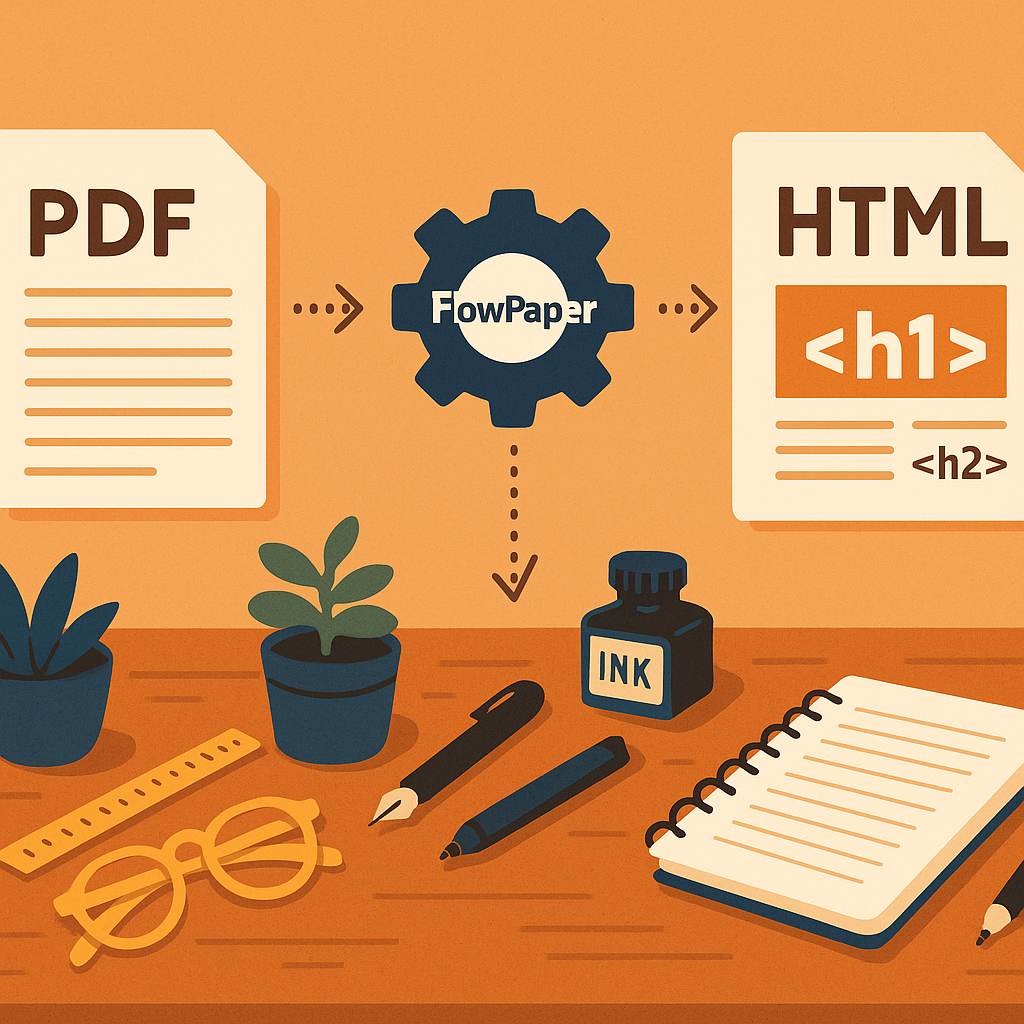
FlowPaper converts your PDF into clean, semantic HTML—exactly what search engines and AI systems prefer.

What You Gain

1. Real Headings
FlowPaper turns visual headings into proper <h1>, <h2>, <h3> tags that search engines depend on.

2. Structured Sections
Text is broken into meaningful segments, giving crawlers better entry points.

3. Better Crawlability
Search engines can navigate and interpret the HTML format far more accurately than a flat PDF.

4. Page-Level Ranking
Sections become individually indexable subpages—boosting visibility for more than just the document’s title.


Why This Matters for AI

LLMs like ChatGPT, Gemini, and others thrive on:

  • Structured HTML
  • Clean semantic markup
  • Accessible hierarchy

Plain PDFs provide none of that. A FlowPaper HTML publication gives AI tools the clarity they need to extract meaning accurately and consistently.


Creating a Search-Optimized Document

Creating a search-optimized document

Making a searchable, AI-friendly document in FlowPaper takes just a few steps:

  1. Import the PDF
  2. Choose the “Elements → Maximize Accessibility” template
  3. Enable SEO Enhancements (usually on by default)
  4. Generate your HTML publication

You get a structured, optimized document ready for search and AI.


Proven Results

Across multiple tests, FlowPaper HTML versions beat PDFs every time:

  • Title searches → HTML ranks higher
  • Section title searches → HTML surfaces consistently
  • Text fragment searches → HTML outperforms PDFs

The advantage is simple: structure.


Conclusion

PDFs are convenient—but they’re terrible for SEO. FlowPaper transforms them into semantic, AI-readable HTML publications that:

  • Rank better
  • Reveal deeper content
  • Improve section-level visibility
  • Increase AI understanding and retrieval

If your organization relies on PDFs, FlowPaper unlocks the reach they’ve been missing.


Further Resources

Avoiding Getting Locked-In - Why FlowPaper Lets You Own Your Flipbooks

4 November 2025

Ever since the dinosaurs evolved (almost!), online publishing has been dominated by closed platforms that start as convenient—but end up locking your content behind subscriptions, restrictive viewers and hidden dependencies. At FlowPaper, we believe your documents, flipbooks and publications should remain in your control.

FlowPaper Tahoe + FlowPaper

In this blog post, we’ll look at how FlowPaper’s self-hosted and licence-based approach gives publishers, businesses and designers more control and long-term freedom than subscription-only services such as Issuu.


The Problem: Content Lock-In & Hidden Costs

On Reddit you’ll find repeated complaints about flipbook platforms and web-PDF embedding in general:

  • “Just had my Issuu invoice through, gone up 420% with no warning! … We were with you for 3 years then boom 4× the previous amount!”
  • “PDFs are tough … the PDF is never truly responsive. … I’ve definitely seen it around so I might have to look further into it.”
  • “None of these embeddable flipbooks are accessible. … I bet the document they create isn’t accessible anyway.”

These aren’t isolated issues—they point to underlying structural problems of many flip-book or PDF embed platforms: you don’t fully control the viewer or data, your content might degrade in performance or accessibility, and you may be locked in.

FlowPaper’s Philosophy: Control, Independence & Ownership

FlowPaper was built around a simple principle: your documents should remain under your control.

That means:

  • You stay in full control and can self-host your flipbooks on your own website/server.
  • No embedding restrictions. You can embed them anywhere—company intranets, learning portals, marketing sites—without dependency on a remote SaaS viewer.
  • Choose between cloud hosting or a one-time/perpetual self-hosting licence, with no requirement to keep paying monthly just to stay online.

When you publish with FlowPaper, your flipbooks remain live as long as you maintain your hosting. No forced subscriptions. No surprise shutdowns when you stop paying.

Flexible Licensing, No Hidden Hooks

Instead of a one-size-fits-all subscription model, FlowPaper offers flexible licensing:

  • Free trial edition: gets you started without needing to sign up for anything.
  • Zine license: one-time fee or perpetual, depending on your scale.
  • Creative and Team editions: a managed hosting option with more analytics—but with an easy escape path anytime.

Whether you’re a designer uploading a catalogue or a developer building dynamic document flows, FlowPaper’s flexible architecture gives you freedom instead of friction.

Choose Publishing Freedom

If you believe your work, brand and audience deserve independence without recurring fees, restrictive viewers or vendor-coupling—then it’s time to explore FlowPaper’s self-hosted options.

👉 Compare editions & pricing

Publish once. Host anywhere. Stay free.